Workflow comparison

realityscan vs meshroom: choose a practical 3D workflow

realityscan vs meshroom comes down to how much setup, control, and cleanup your project can absorb. Use this comparison to pick the better route for fast capture, repeatable processing, or maximum control.

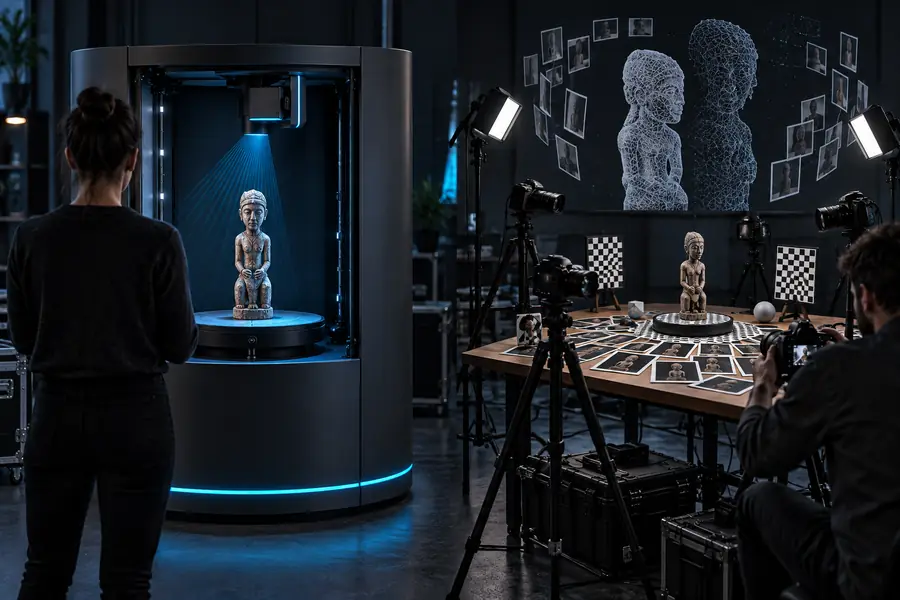
Comparison of RealityScan and Meshroom photogrammetry workflows

Pick by project

Three real scenarios, one pick each

The best choice changes with your subject, deadline, and tolerance for technical setup. These scenarios show where each workflow earns its place.

Field capture teams

You need to record a building detail, sculpture, or outdoor asset on location with a phone and limited time for setup.

Choose RealityScan when capture simplicity and a quick first model matter more than manual reconstruction control.

realityscan vs realitycapture

Technical photogrammetry users

You can organize image sets, tune processing parameters, and inspect intermediate outputs on a workstation.

Choose Meshroom when a node-based pipeline and deeper control over reconstruction stages are worth the extra setup.

realityscan vs polycam

Fast concept iteration

You are testing several objects or spaces and need usable geometry before investing time in detailed cleanup.

Choose RealityScan for a lower-friction first pass, then refine only the scans that prove useful.

realityscan vs realitycapture

Repeatable desktop production

Your team wants a documented process that can be run on prepared image sets with consistent checkpoints and handoff notes.

Choose Meshroom when transparency and repeatability across processing stages outweigh mobile convenience.

realityscan vs polycam

Decision process

Capability matrix

Compare the workflow stages rather than judging either tool by a single finished model. Capture, processing, inspection, and delivery create different strengths.

Define the capture constraint

Decide whether the project is limited by travel, lighting, device access, image organization, or available processing hardware. RealityScan is generally easier to begin with in the field; Meshroom assumes a more deliberate desktop setup.

Match control to the risk

For a quick visual asset, a guided capture path may be enough. For difficult textures, inconsistent image sets, or a need to inspect reconstruction stages, Meshroom's node-based approach provides more opportunities to diagnose and adjust.

Validate the deliverable

Check scale, holes, texture continuity, polygon density, and export compatibility before committing to a production handoff. Neither workflow removes the need for cleanup or a fit-for-purpose quality check.
Honest limitations

Our tradeoff

RealityScan and Meshroom are not interchangeable shortcuts. Each removes some friction while leaving other parts of the 3D workflow firmly in your hands.

Neither fixes poor photography

Blur, reflective surfaces, repeated patterns, moving subjects, and inconsistent exposure can create holes or warped surfaces in either workflow.

WorkaroundUse diffuse lighting, lock exposure when possible, move around the subject steadily, and capture overlapping views from multiple heights.

RealityScan does not replace detailed cleanup

A fast scan can still need hole filling, decimation, retopology, texture correction, scale checks, or edits before it is ready for manufacturing or a polished presentation.

WorkaroundTreat the first model as a measured starting point and reserve a cleanup stage for the final deliverable.

Meshroom requires more technical patience

A desktop pipeline can involve image preparation, hardware constraints, node settings, long processing times, and more interpretation of intermediate results.

WorkaroundCreate a repeatable project template, keep image sets organized, and test a small subset before processing the full capture.

Neither guarantees physical accuracy

Photogrammetry reconstructs visible evidence; hidden areas, thin parts, and uncertain scale remain risks regardless of the chosen application.

WorkaroundAdd reference dimensions, scan from every accessible angle, and verify critical measurements with a physical tool.

Side-by-side view

Comparison matrix

This high-level table separates convenience from control. A stronger fit depends on which attributes are critical for your project rather than on a universal winner.

RealityScan Meshroom
1

Typical starting point

RealityScan

Phone-led or guided capture for a fast first model.

Meshroom

Prepared image sets processed through a desktop node graph.

2

Capture friction

RealityScan

Lower for quick field work and early experiments.

Meshroom

Higher because image organization and workstation setup matter more.

3

Processing visibility

RealityScan

More streamlined and less exposed to every reconstruction stage.

Meshroom

More transparent because stages can be inspected and adjusted.

4

Parameter control

RealityScan

Focused on a simpler path to a usable result.

Meshroom

Broader control for users who want to tune the pipeline.

5

Hardware dependence

RealityScan

Convenient for capture, with final workflow limits depending on the chosen handoff.

Meshroom

More dependent on a capable desktop, memory, storage, and processing time.

6

Best use of iteration time

RealityScan

Testing many subjects quickly and selecting promising scans.

Meshroom

Improving a known image set through deliberate technical iteration.

7

Debugging difficult scans

RealityScan

Less direct access to every reconstruction decision.

Meshroom

Better suited to diagnosing where a reconstruction stage breaks down.

8

Final cleanup requirement

RealityScan

Still required for professional meshes, print preparation, or precise assets.

Meshroom

Still required; more control does not eliminate modeling and texture work.

Questions answered

Comparison FAQ

The right choice depends on whether you value a shorter path to a usable scan or deeper control over how the model is reconstructed.

Yes. Meshroom remains a useful option for users who want a free, node-based photogrammetry workflow with visible processing stages and room to inspect the reconstruction. It is less convenient than a capture-first workflow when speed, mobility, or minimal setup is the main priority.

RealityScan emphasizes a streamlined capture experience and a quick path toward a usable model. Meshroom emphasizes desktop processing, explicit stages, and greater control for users willing to manage image sets and technical settings.

RealityScan is usually easier for a beginner who wants to capture a subject without first learning a full node-based pipeline. Meshroom can still be a good learning tool when the beginner wants to understand how photogrammetry stages affect the result.

Choose Meshroom when your team benefits from inspectable processing, repeatable desktop steps, and more control over reconstruction. Choose RealityScan when field speed and a lower-friction first pass are more valuable, then plan a separate validation and cleanup stage.

Start scanning
Start scanning